Loading...
Every heavy rain takes more of your slope with it. A properly built retaining wall with drainage behind it puts a stop to erosion, stabilizes your yard, and protects your foundation - built to handle Bowling Green's clay soil and 50 inches of annual rainfall.
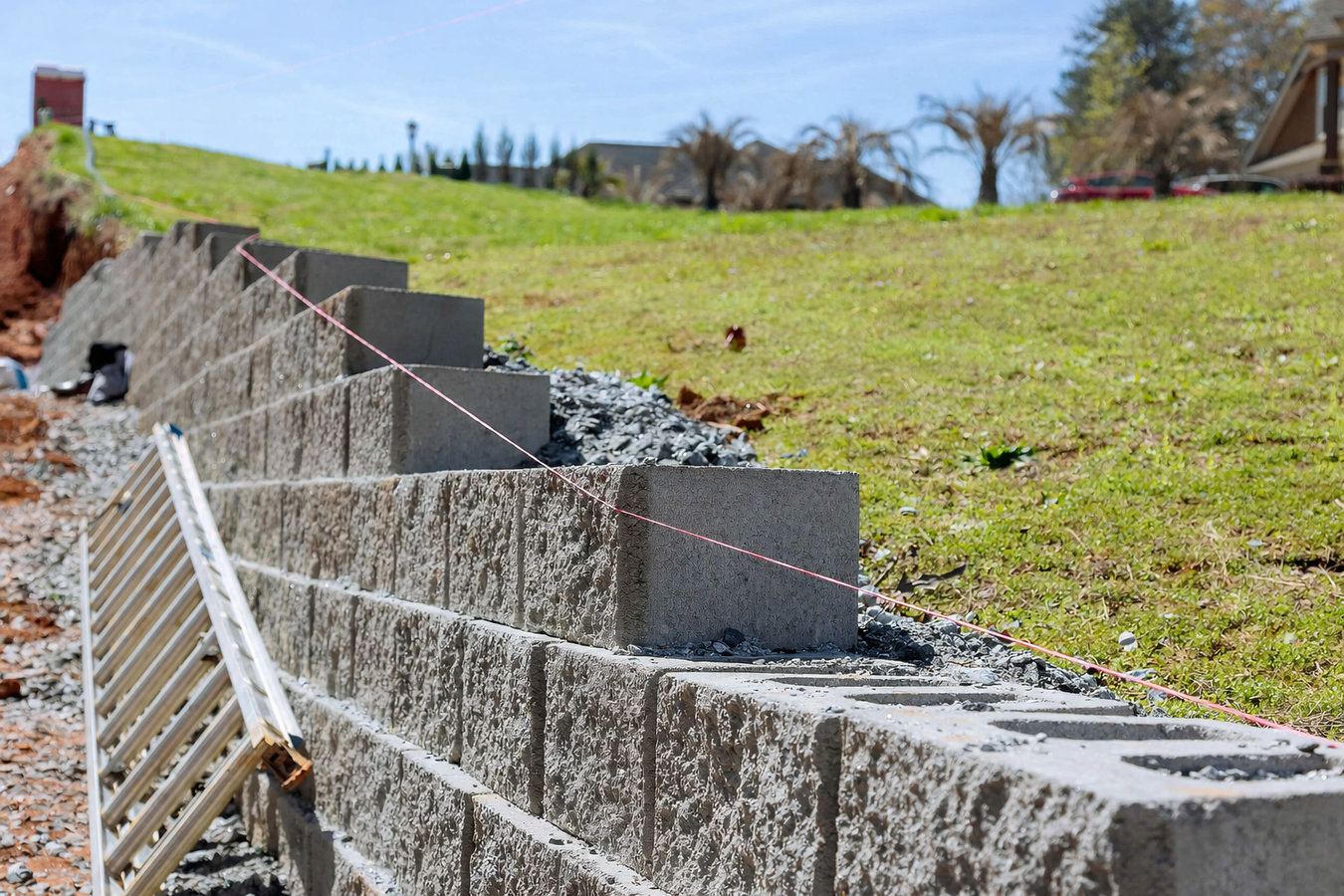
Retaining wall construction in Bowling Green, KY holds back soil on a slope so it does not erode, shift, or wash toward your foundation. Most residential walls are built from concrete block or natural stone on a compacted base with gravel drainage behind them. A typical residential project takes one day to about a week depending on length, height, and material, with most homeowners able to landscape against the wall within a week of completion.
For most Bowling Green homeowners who need a retaining wall, this is not a cosmetic upgrade. It is a fix for a real problem: soil that keeps washing down a slope after every rain, a yard section that is too steep to use, or water that is being directed toward the home's foundation. Bowling Green and the surrounding neighborhoods were developed across naturally hilly terrain, and many lots have slopes that erode or shift without proper support. That problem tends to get worse every year it goes unaddressed.
For homes where the slope sits next to a driveway, we also handle masonry restoration on existing walls that are showing signs of wear before they reach the point of full failure. Catching a wall early is almost always less expensive than replacing it after it has moved too far.
If you notice bare patches of dirt appearing on a hillside after a heavy rain, or if mulch and topsoil keep migrating toward the bottom of a slope, your yard is actively eroding. Bowling Green's high annual rainfall accelerates this process, and what starts as a cosmetic problem can eventually undermine a driveway, a fence line, or even a foundation if left alone.
A retaining wall that has started to tilt forward, developed visible horizontal cracks, or shows gaps between blocks or stones is telling you the pressure behind it has exceeded what it can handle. This is especially common in Bowling Green's clay soil, where water builds up behind walls that were not built with adequate drainage. A leaning wall rarely corrects itself.
If you notice standing water collecting against your home's foundation or in low spots near the house after a storm, a slope on your property may be directing water toward the structure instead of away from it. A retaining wall combined with proper grading can redirect that flow and protect your foundation from long-term water damage.
If there is a section of your yard that is too steep to mow safely, too unstable to plant in, or simply wasted space because nothing stays put on it, a retaining wall can turn that slope into a flat, usable terrace. Many Bowling Green homeowners on hillside lots have added patios, garden beds, or play areas this way.
We build concrete block, natural stone, and tiered retaining wall systems across Bowling Green and surrounding communities. Every wall includes gravel backfill and a perforated drain pipe installed behind it - not as an optional upgrade but as a baseline requirement. Drainage is the part of a retaining wall you cannot see, and it is the part that determines whether the wall lasts 30 years or starts leaning within five. We do not offer a version of this job without proper drainage behind the wall, because a wall without drainage in this area's clay soil is not a solution - it is a delay.
We also handle retaining wall repairs and full rebuilds for walls that are already leaning or cracking. For homeowners whose project involves significant wall structures alongside other masonry needs, we tie in concrete block walls as a standalone service when the application calls for a straightforward, durable structural solution rather than a decorative stone finish.
Best for homeowners who want maximum strength and longevity at a competitive price point.
Best for homeowners who want a high-end, natural look that blends with landscape plantings.
Best for steep slopes that are too tall for a single wall - multiple shorter walls are safer and often more cost-effective.
Best for homeowners whose existing wall is leaning, cracking, or has failed drainage that needs to be corrected from scratch.
Bowling Green averages around 50 inches of rainfall per year, with the heaviest months falling between December and April. That rain lands on clay-heavy soil - the kind that does not drain quickly, swells when wet, and shrinks when it dries out. On a sloped lot, that combination means topsoil, mulch, and gravel migrate down the hill after every significant rain. What starts as a minor erosion problem tends to get worse each year, and in some cases it starts affecting the stability of whatever sits at the bottom of that slope - a driveway, a fence, or a home's foundation. Bowling Green's rolling terrain is genuinely beautiful, but it also means a real share of residential lots have slopes that require active management.
The permit process for retaining walls in Warren County is something we handle on behalf of homeowners as a standard part of the job. Walls four feet and taller require a permit from the county building department before work can begin. We serve homeowners across the region, including Scottsville, KY and Russellville, KY, where similar soil conditions and terrain make retaining walls a common and practical home improvement. For background on soil reinforcement and wall drainage design, the National Concrete Masonry Association publishes technical resources that set the professional standard for segmental retaining wall construction. Kentucky also requires contractors to call Kentucky 811 before any excavation to have underground utilities marked - we do this on every project before any digging begins.
We respond within one business day to schedule a site visit. We will walk the slope with you, ask about what has been happening - erosion, leaning, pooling water - and take measurements before giving you any price.
After the site visit you receive a written estimate that breaks down cost by material, labor, and drainage work. This is the right moment to ask about the drainage plan, how deep the base will be set, and whether a permit is needed.
If your wall requires a permit - common for walls over four feet in Warren County - we handle the application before any digging. We also call 811 to have underground utilities marked, which is required by Kentucky law before any excavation.
The wall goes up layer by layer with gravel and drainage pipe installed behind it as work progresses. Once the wall is complete, the crew backfills with compacted soil, cleans up the work area, and walks through the finished project with you.
Free on-site estimate. Written quote before any work begins. Permits handled for you.
(364) 201-8171Every wall we build includes gravel backfill and a perforated drain pipe behind it. Skipping this step is the single most common reason walls in Bowling Green's clay soil fail within a few years. We do not offer a version of this job without proper drainage.
If your wall is four feet or taller in Warren County, we pull the permit before work starts. Unpermitted work can become a real problem when you sell your home - buyers' inspectors flag it regularly. The permit costs a small amount and protects your property's value.
Warren County's expansive clay soil puts more stress on a retaining wall than sandy or gravelly soil would. We account for that in how deep we set the base, how we compact the backfill, and how we size the drainage system - not as an upgrade, but as standard practice.
Kentucky law requires contractors to call 811 to have underground utilities marked before any excavation. We do this on every project as a matter of course. It is a simple step that separates careful contractors from careless ones, and it protects your yard from accidental utility damage.
The things that make a retaining wall last in Bowling Green are not complicated, but they require discipline: a deep, compacted base; proper drainage behind the wall; a permit that puts the work on record; and a contractor who calls 811 before touching the ground. Those are not extras - they are the baseline. Everything else follows from getting those four things right.
Existing masonry walls showing spalling, staining, or joint erosion can be restored rather than replaced with targeted masonry restoration work.
Learn MoreConcrete block is a dependable material for retaining applications where strength and longevity are the primary requirements.
Learn MoreSpring rain season fills contractor schedules fast - call now or request a free written estimate before slots close out.